Pet beds
Calming dog beds: what they are and do they work?
What a calming dog bed is, what the evidence says, which dogs like a round bed with raised sides, how to pick the size and what to do if your dog is anxious.
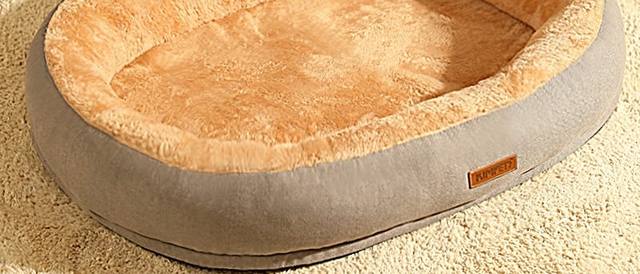
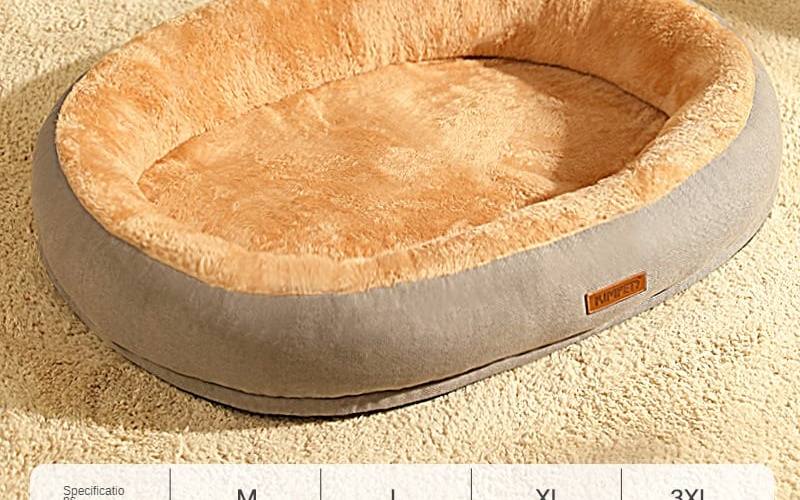
Search for a dog bed online and you will soon find beds sold as calming, anti-anxiety or donut beds. They look alike: round or oval, with a deep padded rim and a long, fluffy lining. Some of the claims made for them are bold. This guide explains what these beds are, what the evidence says, which dogs tend to like them and how to choose one that fits.
We sell beds in this style, our plush oval pet beds. We do not call them calming, and the reason is explained below.
What a calming dog bed is
There is no standard for the word. In practice, beds sold as calming share a few features:
- A round or oval shape, so the dog can curl up in the middle.
- A raised, padded rim all the way round to lean against or rest a head on.
- A long plush or faux fur lining, soft enough for the dog to sink in a little.
- A soft base, often with a cushion or a foam insert.
Some are filled loose, like a beanbag, and some have a firm base with a soft rim. Some have a removable cover and some do not, which makes a big difference when it comes to washing.
Do calming beds work?
We looked for scientific studies and could not find any published research that tests whether a calming bed reduces anxiety in dogs. The Dogs Trust, writing about separation anxiety, puts it plainly: there is no scientific evidence that any over-the-counter or non-prescription products work.
That does not mean the beds are useless. It means the honest claim is smaller. A good bed gives a dog a comfortable place of its own to rest, and the RSPCA's advice is to give your dog a comfortable, dry, draught-free, clean and quiet place to rest undisturbed. Rest matters: the PDSA says most dogs need 14 to 16 hours or more of sleep in 24 hours, with puppies, older dogs and dogs that are unwell needing the most.
The shape helps some dogs too. Dogs often sleep curled up in a ball, and vets say that position conserves body heat and protects the belly. The RSPCA notes that round or oval beds with a side are great for when your dog wants to curl up. A bed with a rim simply suits that way of sleeping.
Which dogs like a round bed with a rim?
Watch how your dog sleeps for a few days before you buy.
| How your dog sleeps | Bed that tends to suit |
|---|---|
| Curled up tight in a ball | Round or oval bed with a raised rim |
| Leaning against the sofa or a wall | Bed with a rim to lean on |
| Stretched out flat on its side | Mattress or large flat bed |
| Hiding under tables or in corners | Covered or igloo bed |
| Changes position a lot | Large bed with low sides, or more than one bed |
The RSPCA suggests that a shy or nervous dog may benefit from an igloo type bed so it can hide away in comfort. Some dogs prefer a covered bed or a crate with a blanket over it to a round bed.
Choosing the size
The RSPCA says a bed should be large enough for your dog to lie comfortably in all its natural positions, and asks a good question: your dog may fit when curled up, but can it also stretch out its legs?
- Measure your dog lying stretched out, from the nose to the base of the tail.
- Measure it curled up, across the widest point.
- Compare both with the inside of the bed, not the outside. A thick rim takes up space.
Our 60 x 45 cm oval bed is recommended by the supplier for cats and small dogs up to about 7.5 kg. The 75 x 55 cm size suits dogs up to about 15 kg. If your dog sits near the top of the weight range or likes to stretch out, choose the larger size.
Where to put the bed
Position matters as much as the bed. The RSPCA advises somewhere warm and draught-free, and giving your dog options.
- Quiet, not isolated. A corner of the living room is often better than a busy hallway or a cold utility room.
- Away from radiators and doors. Too warm next to a radiator, too draughty by an outside door.
- On a non-slip floor, or against a wall, so the bed does not slide when your dog jumps in.
- A second bed in another room gives your dog a choice.
Helping your dog use a new bed
- Put a blanket or an old jumper that smells of home in the bed.
- Drop a treat in it and praise your dog for getting in.
- Leave it where your dog already likes to rest.
- Never push your dog into the bed or use it as a place for punishment.
When a bed is not enough
Some dogs are anxious for reasons a bed cannot change. The RSPCA lists signs of separation-related behaviour that include destructive behaviour, howling, barking or whining, and toileting in the house when left alone. It also points out that health problems can cause or add to the behaviour.
If you see these signs:
- See your vet first to rule out pain or illness. The Dogs Trust also says it is important to see a vet.
- Ask about a qualified behaviourist. The RSPCA suggests a clinical animal behaviourist, and the PDSA recommends finding a professional such as an ABTC certified behaviourist.
- Keep the bed as part of the routine, a comfortable place your dog can choose, not the whole plan.
Washing matters
Plush linings collect hair and smells, so a bed you can wash is easier to live with. Look for a zip and an insert that comes out. Both our oval beds have a zipped base, so the foam insert can be removed before the cover goes in the machine. Our guide on how to wash a dog bed goes through it step by step.
In short
A round bed with a raised rim is a good choice for a dog that likes to curl up and lean, and many dogs clearly enjoy one. There is no published evidence that it treats anxiety. Buy it for comfort, size it for how your dog really sleeps, put it somewhere quiet and warm, and if your dog seems anxious, talk to your vet.
Frequently asked questions
Do calming dog beds really work?
We could not find any published study showing that a calming bed reduces anxiety in dogs, and the Dogs Trust says there is no scientific evidence that any over-the-counter or non-prescription products work for separation anxiety. Many dogs simply like a round bed with raised sides, because they can curl up and lean against the rim.
What is the difference between a calming bed and a normal dog bed?
Mostly the shape and the fabric. Beds sold as calming are usually round or oval, with a deep padded rim and a long faux fur lining. A normal bed may be flat, a mattress or a box shape. The word calming is a marketing term, not a standard.
What size calming bed does my dog need?
Measure your dog lying down, both curled up and stretched out. The RSPCA says a bed should be large enough for your dog to lie comfortably in all its natural positions, so if your dog likes to stretch out, size up.
My dog is anxious when left alone. Will a new bed help?
A comfortable bed in a quiet spot is part of a good routine, but it is not a treatment. The RSPCA and the Dogs Trust both advise seeing your vet first, because health problems can cause or add to the behaviour, and then a qualified behaviourist if needed.